
That nest tucked under your eave looked harmless a few weeks ago. Now it’s the size of a grapefruit, and you’ve had two close calls just walking to the back door. The instinct to grab a can of spray and handle it yourself makes sense; the hardware store aisle makes it look easy, and the problem is literally right outside your door.
But DIY wasp nest removal is one of the more dangerous calls a homeowner can make during a South Carolina summer. Every year, people end up dealing with multiple stings, allergic reactions, and colonies that are worse off than before they started. Here’s what you need to know before you pick up that can, and why calling a professional is the move that actually solves it.
Wasps Sting More Than Once
Most people assume wasps work like honeybees. One sting and it’s over. Wasps don’t work that way. A single wasp can sting multiple times, and when a nest feels threatened, it doesn’t send one wasp to investigate. The whole colony responds.
What Happens When a Nest Is Disturbed
Paper wasps, yellow jackets, and hornets are the three species you’ll most likely encounter around Upstate SC homes, and all three follow this pattern. What starts as a few wasps circling can escalate to dozens within seconds. For someone with an allergy to insect venom, one sting is a medical emergency. For everyone else, multiple stings in a short window cause serious pain, significant swelling, and in some cases a systemic reaction that needs hospital care.
This isn’t a fringe scenario. It happens to homeowners every summer who thought they were being careful and had the right product. The biology works against you. Wasps are built for fast, coordinated defense.
Nests Are Trickier Than They Look
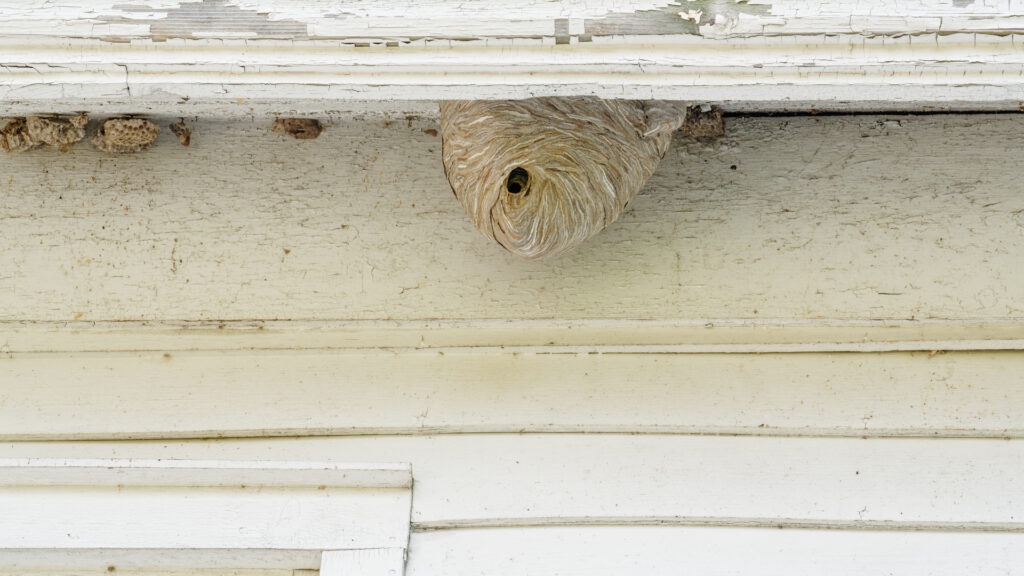
A nest that looks small from the outside can hold hundreds of wasps inside. Yellow jacket colonies regularly reach several thousand workers by late summer. The one you spotted in May is significantly more dangerous by July, and the visible entrance is almost never the whole picture.
Wasps also build in places that make a safe DIY approach nearly impossible:
- Inside wall voids and attic spaces where the colony can’t be seen or reached
- Underground burrows, one of yellow jackets’ most common nesting choices in SC
- High eaves and overhangs that require a ladder to reach
- Dense shrubs where you won’t realize how close you are until it’s too late
Getting near any of these locations while holding a consumer spray can (without protective gear, without knowing where the colony exits) puts you at real risk of startling the nest before the product even reaches it. That’s when most stings happen.
Common DIY Mistakes
Even homeowners who research before attempting nest removal make the same critical errors. Treating at night gets recommended in a lot of online guides because wasps are less active after dark. What those guides miss: wasps still respond to light, vibration, and sound. Shining a flashlight at an underground yellow jacket burrow is enough to set off a defensive response.
Product fit matters just as much as timing. Consumer wasp sprays work on exposed aerial nests when you have distance and a clear shot. For nests inside walls, underground, or in tight enclosed spaces, they’re poorly suited, and using the wrong product in the wrong situation often scatters the colony rather than ending it.
A few other patterns that backfire:
- Knocking down a nest without treating the colony first sends surviving wasps straight back to rebuild
- Sealing one entry point before the colony is gone traps live wasps inside; they’ll chew through drywall looking for a new exit
- Treating visible activity at the surface without reaching the full colony leaves the problem intact
When is Wasp Season in Upstate SC?
Colonies start small in early spring, when queens are just building. Most homeowners don’t notice them yet. By midsummer, that small start can be several hundred workers, and the colony’s behavior shifts as the season moves into August and September.
Late summer is when wasps get most aggressive. Natural food sources decline heading into fall, and colonies defend territory harder than at any other point in the year. It’s also exactly when most homeowners finally notice a nest and decide to do something about it. A nest that’s been quietly growing in an eave since April becomes obvious in August when activity picks up. Understanding when yellow jackets peak helps you get ahead of the problem rather than react to it at the worst possible time.
Regular professional treatments throughout the season stop colonies from getting to that point in the first place.
How Professional Removal Works
Species identification comes first. Paper wasps, yellow jackets, and hornets each have different nesting habits, different aggression levels, and different treatment approaches. A one-size-fits-all method from a hardware store shelf can make the situation harder to resolve depending on what you’re actually dealing with.
We locate all entry and exit points before any product is applied. For nests inside walls or underground, this step is what separates a treatment that works from one that just moves the problem around. We treat the colony at the source, not just the visible entrance. Professional-grade products provide faster knockdown and longer residual coverage than consumer options.
Our technicians arrive with the protective gear, the training, and the right equipment for the situation. No ladder held under pressure. No flashlight near an underground burrow. No guessing about what’s inside a wall void. If you want background on the specific stinging insects we deal with in Upstate SC, our South Carolina wasp guide covers each species and what sets them apart.
Schedule Wasp Nest Removal in Upstate SC
Wasp nest removal is included in every Action Pest Services plan. There’s no add-on charge, no separate call-out fee. Whether you’ve got paper wasps on the porch, a yellow jacket colony in the ground, or hornets in the eaves, your plan covers it. And if they come back between visits, so do we. That’s our service guarantee.
Existing customers can call the moment they spot a nest. New customers can get started with an initial treatment and have coverage through the rest of wasp season and beyond. Waiting just gives the colony more time to grow. Call us at (864) 301-6535 or request service online.
We serve homeowners throughout Upstate SC, including: