
South Carolina’s humid summer keeps wasps active from early spring through October. Several species cause indoor problems here.
Paper wasps and red wasps build their open, umbrella-shaped nests under eaves and around porches, where workers sometimes drift inside through open doors. Yellow jackets are the bigger structural concern because they nest inside walls. Mud daubers show up too, but they rarely cause issues beyond the occasional mud streak.
Once you know how wasps get in the house, fixing the problem stops being guesswork. The pest library on wasps, yellow jackets, and hornets is a good place to confirm what you’re seeing.
Common Entry Points Around Your Exterior
Wasps don’t push through closed doors. They slip through openings most homeowners walk past every day:
- Gaps around utility lines where cable or AC penetrations meet siding
- Warped wood along soffits and fascia, especially near the roofline
- Ridge and gable vents that open straight into attic spaces (a yellow jacket favorite)
- Weep holes in brick veneer let wasps in, but you can’t plug them. They have to drain.
- Cracked caulk or worn weatherstripping around door and window frames
- Broken or stuck flaps on the dryer and bathroom exhaust vents
- Torn window screens and gaps along the porch screening
Most homeowners look too high or too low. Walk your exterior on a sunny morning and watch where wasps land, hover, or disappear into the siding. They’ll show you what your eyes are missing.
Why Wasps Keep Coming Back to the Same Spots
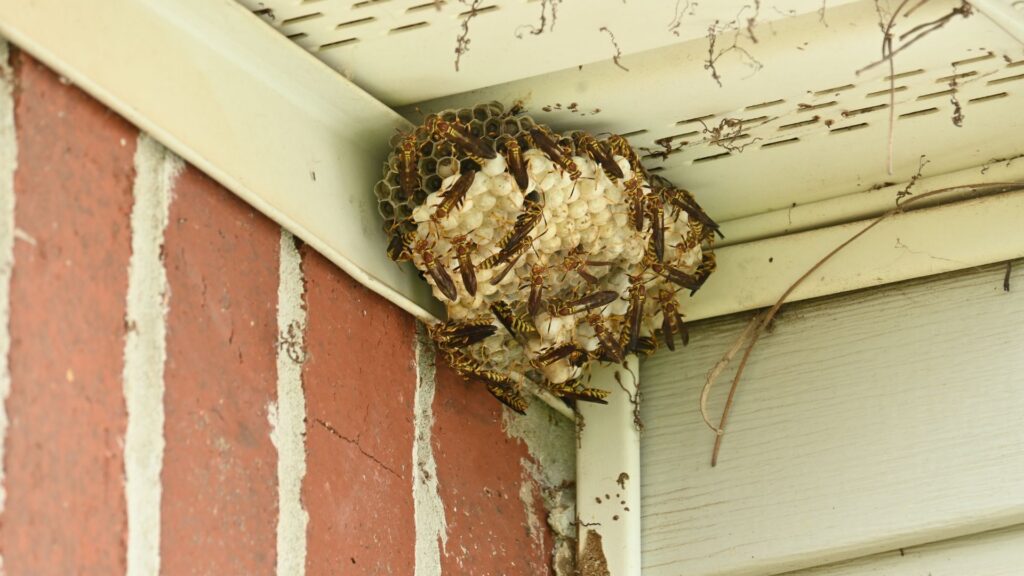
Some homes get hit year after year. If wasps getting into your house has turned into a yearly conversation, you’re not unlucky. Wasps leave pheromone markers on spots that worked, and those scent cues pull new colonies back the following season, even after you’ve knocked an old nest down.
Eaves and shaded soffits hold the kind of heat and dryness wasps want for a nest. Old nests left in place quietly tell passing wasps the location is safe. When a wasp keeps getting into the house through the same window or vent every year, sealing the structural gap matters more than removing the nest itself.
The South Carolina wasp guide breaks down which species favor which spots.
How to Get Rid of Wasps in Your House
Skip the swatter. Crushed wasps release alarm pheromones that pull more wasps toward the area, and quick movements raise your sting risk with yellow jackets and red wasps, especially. Knowing how to get rid of wasps in house situations starts with staying calm and giving them a way out.
For one or two wasps already inside:
- Close any interior doors so the wasp stays in one room
- Open the nearest window or door to the outside
- Lights matter here. Turn the interior ones off and the porch light on
- If it still won’t leave, a drinking glass and a piece of cardboard will trap it
When new wasps keep showing up over several days, and you’re still asking how a wasp got in your house, you’re past the stray-visitor stage. Getting rid of wasps in house spaces at that point means tracking down the nest. Knowing how to get rid of wasps in house walls or attics safely is a different job from clearing one off a window screen.
When the Nest Is Inside a Wall or Attic
Faint buzzing inside a wall is usually the first sign. Other tells: wasps coming and going from one specific point on your siding, or steady activity around an attic vent. The nest sits inside your home’s structure. Working out how to get rid of a wasp nest in the house walls is where most DIY attempts go sideways.
Don’t seal the entry hole. Trapped wasps will chew through drywall to escape. The colony moves from your attic into your living room overnight. Spraying aerosol insecticide into a wall void rarely reaches the queen, and the dead wasps left behind decompose in your insulation. That mess draws beetles and ants in for months afterward.
Professional treatment uses a dust formulation. Wasps pick it up on their way in and out, then carry it back into the colony. Eventually, it reaches the queen. Once activity stops, the entry can be sealed for good. For more on the species behind most indoor nests across the region, read up on South Carolina paper wasps.
Stop Wasps from Getting Back In, Call Action Pest Services Today
Sealing one gap rarely holds up through the next nesting season. The active nest has to come out, and every other entry point has to be closed before the next round of scouts shows up.
Action Pest Services has handled wasp problems across South Carolina for years, and we know where these pests get in around homes here. Contact us today before the colony grows large enough to push into your living space.
Proudly serving: