
A yard that was fine to mow in June suddenly has yellow jackets boiling out of the ground in August. Nothing about the lawn changed. The colony did. Yellow jackets get noticeably more aggressive as summer winds down, and the reason has less to do with the weather than with what’s happening inside the nest itself.
Colonies Get Aggressive in Late Summer
A yellow jacket colony starts small each spring, built from scratch by a single queen who survived the winter alone. Through early summer, workers are almost entirely focused on raising more workers, feeding developing larvae a diet of chewed-up insects and other protein.
By August, that same colony can hold several hundred workers, sometimes more, all defending a nest that’s grown a lot more valuable to protect than it was two months earlier.
The shift that really changes behavior happens inside the nest. Late in the season, colonies stop raising new workers and start producing next year’s queens and males instead. Fewer larvae in the nest means less of the sugary secretion those larvae normally produce for the adults feeding them.
Workers that spent all summer getting a reliable sugar source suddenly don’t have one. Our South Carolina wasp guide covers this seasonal cycle for other stinging insects, not just yellow jackets.
Food Competition Drives the Behavior
That’s when yellow jackets start showing up at picnics, trash cans, and soda cans in a way they weren’t a month earlier. It’s not random. Workers are scavenging hard for sugar to replace what the colony stopped supplying internally, and a can of soda or an unattended plate of food is an easy target compared to whatever’s left in the yard this late in the season.
More workers competing for a shrinking set of food sources also means more of them showing up in the same places people are. That’s a big part of why yellow jacket aggression late in the summer feels so much worse than it did earlier in the year, even in yards where nobody has gone near a nest.
It’s less that any single worker got meaner and more that there are simply more workers, hungrier ones, covering more ground.
Where Nests Turn Up Around SC Homes
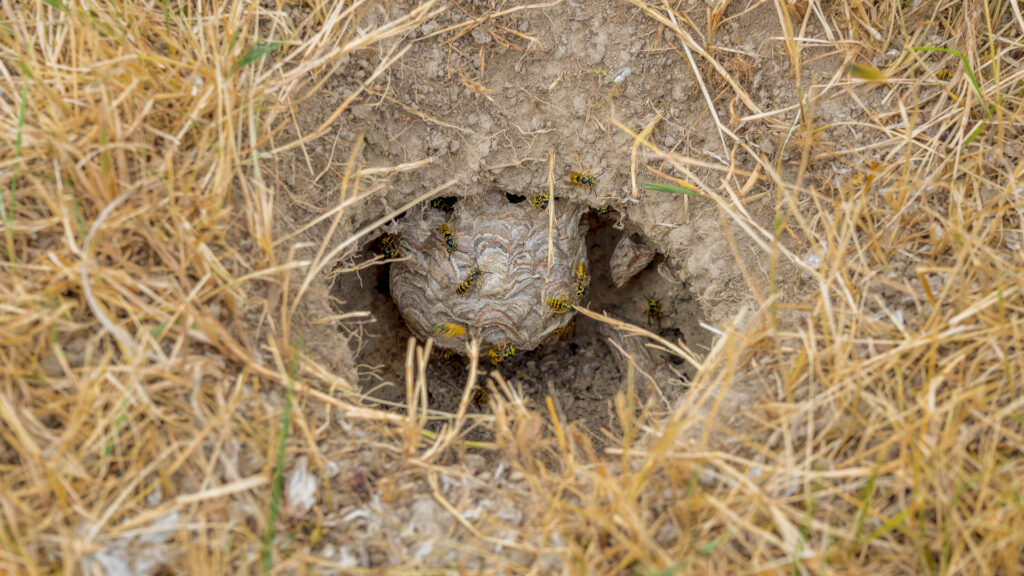
Ground nests are the most common type we deal with, usually built in an abandoned rodent burrow, under a woodpile, or along the edge of a garden bed. They’re also the easiest to disturb accidentally, since there’s no visible above-ground structure beyond a small entry hole that workers fly in and out of.
Older homes tend to give up the other common nest spot: wall voids and attic space, wherever a gap has opened around siding or a vent. A nest built inside a wall can grow for weeks before anyone notices, since the activity stays hidden until workers start using an entry point close to a door or window.
Our wasps, yellow jackets, and hornets guide has more on identifying which species you’re dealing with.
Spotting a Nest Before You Get Stung
A steady line of yellow jackets flying in and out of the same small opening, whether it’s a hole in the ground or a gap in siding, is usually the first real sign. Watch that spot for a minute or two before deciding it’s nothing.
A few other signs are worth checking before you get closer than you’d like:
- Workers flying a consistent path back and forth to one spot in the yard
- A faint buzzing sound coming from inside a wall or attic space
- Increased activity around trash cans or outdoor food, especially in the afternoon
- Small holes in the ground with visible insect traffic, not just one or two strays
None of these guarantee an active nest by themselves, but two or three together are a good reason to keep your distance and get it checked out.
Staying Safe Around Active Nests
If you already know where a nest is, the safest move is to treat the whole area as off-limits until it’s dealt with. A few situations turn a known nest into an actual sting incident more often than people expect:
- Mowing or trimming within a few feet of a ground nest entrance
- A wall gap sealed up before the colony inside is dealt with
- Kids or pets playing close to a spot with known yellow jacket activity
- Pressure washing or knocking loose siding near a suspected wall entry point
Treating the whole area as off-limits, not only the visible entrance, is what keeps it safe until the nest is gone.
Why do yellow jackets chase you instead of stinging once and moving on? It comes back to the alarm response. A threatened worker doesn’t just defend itself in place; it pursues. A colony under pressure late in the season has more workers ready to join that pursuit than it would have back in June.
Running in a straight line away from the area, rather than swatting or standing your ground, is what actually ends the chase fastest.
That advice flips once you haven’t been noticed yet. Slow, deliberate movement is what keeps it that way. Yellow jackets track motion, and swatting or bolting near a nest you’re walking past is what turns a close call into a full yellow jacket attack that didn’t need to happen in the first place.
When DIY Removal Goes Wrong
By late summer, a nest that started as a few dozen workers in June can hold hundreds.
Over-the-counter sprays are built for smaller, earlier-season colonies, and using one on a mature nest often does more to agitate the colony than eliminate it. That’s when a single removal attempt turns into multiple people getting stung, including people who weren’t anywhere near the nest to begin with.
Ground nests and wall voids both share the same problem: the visible entrance rarely reflects how large the colony is beneath or behind it. That mismatch is exactly why professional nest removal exists as a separate service rather than being bundled into general pest control.
Schedule Nest Removal with Action Pest
If you’ve found a nest, or you’re seeing enough yellow jacket activity around your yard to suspect one, this is the time of year we get called out for it most. We handle nest removal throughout the Upstate, sized to the colony you’re actually dealing with rather than a one-size-fits-all treatment.
Call us at 864-399-9262 or reach out through our contact page and we’ll get someone out to find the nest and clear it safely.
We provide yellow jacket and wasp control throughout these South Carolina communities: